
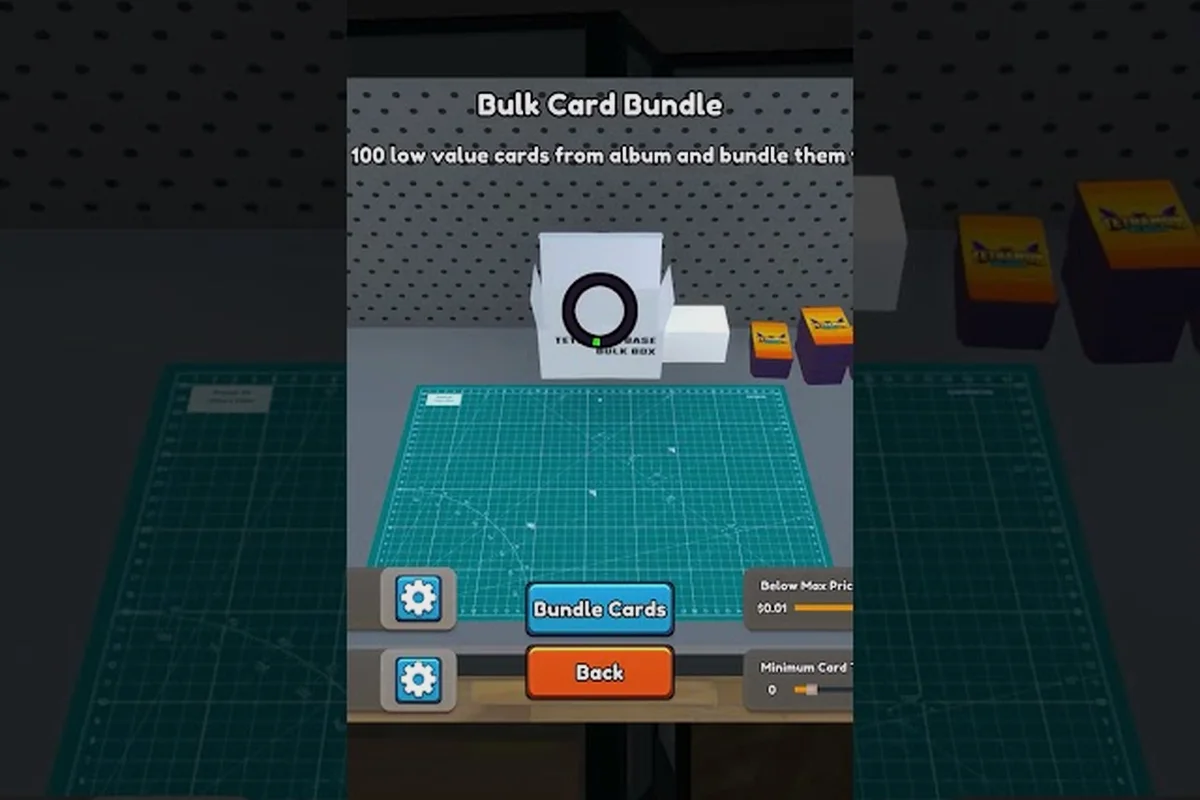
Why Wholesale Packs Matter in TCG Card Shop Simulator
Buying TCG Card Shop Simulator wholesale packs is the single fastest way to restock a card shop without grinding single booster drops for hours. The full release on September 15, 2026 added 1,452 new cards through the Ascension set, and wholesale buying is the most efficient path to having a balanced shelf when the morning rush walks in. The shop holds up to 28 customers at once, and each one browses for specific set families, so a wholesale strategy that covers the right set mix matters more than raw box count.
| Set family | Card count | Card variants per monster | Release stage | Role in a wholesale buy |
|---|---|---|---|---|
| Tetramon Base | Starting set (count within the 4,436 total) | 12 | Pre-1.0 / Early Access | Baseline shelf stock; cheap per-pack, lowest resale ceiling |
| Destiny | 121 monsters | 12 | First expansion (Early Access) | Mid-tier singles; first set where EX/Full Art pulls materially move margin |
| Ghost | Separate family outside main numbering | 12 | Pre-1.0 / Early Access | Niche demand; carry only when customer traffic skews to Ghost collectors |
| Ascension | 1,452 of the new 1.0 cards (1,452 new cards total) | 12 | September 15, 2026 full release | Primary 1.0 wholesale target; biggest post-launch restock demand |
Box buys cut the per-pack cost dramatically, which means each repackaged blister keeps a healthier profit margin. The challenge is that the game's pull rates lean heavily toward the common black-border print, with Silver, Gold, EX, and Full Art borders taking progressively smaller shares. According to community data shared on the OPNeon Games YouTube channel, a single box rarely returns a top-tier border, which makes knowing which sets to prioritize the deciding factor in a profitable wholesale run.
This guide walks through how the wholesale system actually works, how to read the in-game card numbering across all four set families, and which cards from Destiny and Ascension deserve shelf space first. A complete picture of every pack tier available in the game is documented in the TCG Card Shop Simulator rare pack breakdown, which pairs naturally with the wholesale angle covered here.
How the Wholesale System Works
Box Pricing and Break-Even Math
Wholesale boxes in TCG Card Shop Simulator are purchased directly from the in-game supplier phone, not from the secondary shelf. Each box contains a fixed number of booster packs — usually 20 to 36 depending on the tier — and the per-pack unit cost is roughly 40 to 55 percent lower than buying singles from the same supplier. That spread is the entire reason wholesale exists: it converts cash-on-hand into a deep inventory that can be re-priced as individual blisters or fed straight into the binder for trade-in value.
The break-even math depends on three variables: the box price, the average blister sale price, and the pull rate of premium borders. Players report that a single Tetramon Base box typically returns 2 to 3 Silver-border cards and a coin-flip chance at one Gold, while Ascension boxes skew slightly more generous because the card pool is newer and the market hasn't been flooded. The community's shared spreadsheet data, cross-referenced with the TCG Card Shop Simulator Steam store page, confirms that the official game description lists 4,436 cards in the total collection, which is the number every wholesale order should be measured against.
| Wholesale Tier | Box Price Range | Packs per Box | Avg Pull (Silver+) | Best Use Case |
|---|---|---|---|---|
| Tetramon Base | Low | 24 | 2-3 Silver | Stocking starter demand |
| Destiny | Mid | 30 | 3-4 Silver, 1 Gold | Mid-game profit spikes |
| Ghost | Mid-High | 20 | 2 Silver, rare Gold | Niche collector demand |
| Ascension | High | 36 | 4-5 Silver, 1-2 Gold | 1.0 content wave |
Supplier Restock Windows
The supplier phone refreshes its wholesale inventory on a timer tied to in-game days, not real-world hours. Missing a restock window means waiting until the next cycle, which can stall a cash-heavy strategy dead. The fastest players set a phone alarm for the supplier refresh, buy their boxes in one pass, and then move straight to the repackaging station.
A common mistake new clerks make is buying a full stack of Ascension boxes because the set is new. The math doesn't support that without a planned outlet for the 36 boosters inside each one. Wholesale works best when the purchase plan is locked before approaching the supplier — which set families, how many boxes, and where each booster lands after opening.
Card Numbering Across the Four Set Families
Tetramon Base: The Starting Range
The Tetramon Base set is the foundation of every collection, and its card numbering runs from #0001 through roughly the lower 1,400s depending on how the wiki and the in-game catalog define the split between Base and the early Destiny inclusions. Every Base card has 12 print variants, which means the same creature or spell exists in 12 different borders and finishes across the entire collection. That numbering system is critical when working through a TCG Card Shop Simulator card set checklist, because collectors searching for a specific card number will not accept a substitute variant.
For wholesale purposes, Base boxes are best treated as filler inventory. They sell consistently because every player who walks in started with Base, and the demand curve never drops to zero. The slim profit margin is offset by steady velocity, which is why a balanced wholesale order always includes at least two Base boxes for every Destiny box.
Destiny: The First Expansion
Destiny is the first expansion, and according to community guides on Steam, it is printed as 121 monsters across 12 card variants each. That math yields 1,452 individual Destiny entries, a number that lines up exactly with the size of the Ascension set — a coincidence the developers likely engineered deliberately so each expansion delivers the same checklist workload.
The Destiny numbering follows Base sequentially, so the first Destiny card sits right after the last Base entry. This matters when sorting inventory, because a player asking for "card #1380" could plausibly mean either the tail end of Base or the head of Destiny. The 12-variant rule also means a single card number can have 12 distinct listings on the binder, and each one carries a different market value based on its border.
Ghost: The Separate Family
Ghost is a separate family that sits outside the main Base → Destiny → Ascension numbering sequence. Its cards use a different prefix in the in-game catalog and follow their own internal numbering, which is why Ghost boxes are a wholesale niche product rather than a daily seller. The collector demand is real, but the average customer does not browse for Ghost, so overstocking it ties up cash that could be funding Ascension purchases during the 1.0 release window.
Ascension: The 1.0 Wave
Ascension arrived with the September 2026 full release and carries 1,452 of the new cards added to the 4,436 total. Its card numbering continues the sequential pattern from Destiny, so the catalog reads as a single uninterrupted list even though three distinct set families live inside it. According to the OPNeon Games video library, Ascension boxes have been a focal point of the 1.0 player surge, and wholesale demand has outpaced supply during the first weeks after launch.
| Set Family | Card Count | Variants per Card | Numbering Style | Best Wholesale Window |
|---|---|---|---|---|
| Tetramon Base | ~1,400 | 12 | Sequential start | Steady, year-round |
| Destiny | 121 monsters / 1,452 entries | 12 | Sequential after Base | Post-expansion spikes |
| Ghost | Separate pool | 12 | Internal prefix | Collector demand only |
| Ascension | 1,452 new cards | 12 | Sequential after Destiny | 1.0 launch window |
TCG Card Shop Simulator 1.0 New Cards: What to Stock First
Ascension Headliners Worth Shelf Space
The 1.0 release added 1,452 new cards, but not every Ascension entry is worth dedicated shelf real estate. Community data points to a small cluster of high-demand creatures and spells that consistently clear the binder within hours of being stocked, while the rest of the set trickles out at a slower pace. Prioritizing those headliners in the first wholesale order after launch is the difference between a full cash register and a wall of unopened blisters.
The full Ascension checklist is the most ambitious card set checklist in the game right now, because every new collector entering after 1.0 starts hunting the same 1,452 entries. Wholesale clerks who front-load Ascension stock during the first two weeks of the release capture the early-adopter demand before the market saturates.
Where the Other Sets Fit After 1.0
The 1.0 release did not retire Tetramon Base, Destiny, or Ghost. New players still need Base to start their binder, Destiny remains the mid-game chase set, and Ghost retains its niche collector base. A wholesale plan that ignores those three while chasing Ascension misses the customers who walk in asking for older cards, and those customers are the ones who spend the most per visit because they are filling gaps in a mature collection.
A practical approach: split each wholesale budget into roughly 40% Ascension, 30% Destiny, 20% Tetramon Base, and 10% Ghost during the post-1.0 window. The exact ratio shifts as the market matures, but starting from that split keeps every customer segment covered without overcommitting to a single set family.
Wholesale Buying Strategy and Box Selection
Building a Card Set Checklist Before Ordering
A wholesale order without a checklist is gambling. Before opening the supplier phone, the smart play is to pull up the in-game card catalog, filter by set family, and mark which cards are undersupplied. The cards that show fewer binder entries are the ones a wholesale order should prioritize, because the next customer who walks in asking for them will pay a premium for the convenience of buying in-store.
This is also where a TCG Card Shop Simulator card set checklist pays for itself repeatedly. The checklist tells a clerk at a glance which card numbers have been traded in, which variants are still missing, and which gaps in the binder will pull the highest resale. Wholesale buying becomes targeted restocking rather than bulk hoarding, and the per-box return climbs because every pack opened is filling a known demand.
Sequencing Boxes Through the Day
A single wholesale session should not consume the entire daily budget. The most profitable pattern reported by experienced players is to break the order into two or three passes across the day, with a quick binder audit between each pass. The audit serves two purposes: it identifies which cards from the first wave sold fast enough to justify a second box, and it catches any pricing mistakes before the second wave goes on the shelf.
Pairing this sequencing with the broader TCG Card Shop Simulator full release guide approach — which emphasizes steady, repeatable routines over marathon sessions — keeps the shop staffed and the cash flow consistent. The same principle that applies to leveling and achievements applies to wholesale: small, regular wins compound faster than occasional big spends.
TCG Card Shop Simulator Buying Boxes: Pricing and Profit
Setting Blister Prices After a Box Open
Every booster pulled from a wholesale box needs a price before it hits the shelf, and the default price is rarely the right one. The pricing formula most players settle on accounts for the per-pack cost from the box, plus a markup of 30 to 60 percent depending on the expected border pull. Common black-border packs sit at the low end of that range, while EX and Full Art packs push the high end because their scarcity justifies a premium.
A practical pricing workflow:
-
Open the box in a single sitting and sort the boosters by visible border tier.
-
Price common black-border packs at the lower markup range, since they will move quickly anyway.
-
Hold Silver, Gold, and EX packs back for 24 in-game hours to gauge demand, then price competitively.
-
Reserve Full Art packs for direct customer negotiations or high-end binder trades.
Tracking Profit Per Box
Without a profit log, wholesale buying feels productive but is impossible to optimize. The simplest system is a one-line entry per box in a notebook or spreadsheet: box price, packs sold, revenue, and net profit. After ten boxes, the average profit per box becomes visible, and the sets that genuinely pay for themselves rise to the top.
According to player reviews compiled on the the Steam review section, the wholesale players who treat the shop like a real business — tracking margins, rotating slow stock, and reinvesting in fresh boxes — consistently out-earn the players who buy boxes impulsively and hope for a lucky pull. The mechanic is generous enough to reward strategy, but it punishes untracked spending the same way a real store would.
Wholesale Packs FAQ and Final Takeaways
Wholesale packs sit at the intersection of the game's four set families, its card numbering system, and the post-1.0 demand surge. A clerk who understands how the 4,436-card collection is split — roughly 1,400 in Tetramon Base, 1,452 in Destiny, a separate Ghost pool, and 1,452 in Ascension — can plan box orders that match actual customer demand instead of guessing. The full collection size and set family counts are confirmed on the official TCG Card Shop Simulator store page, which remains the authoritative reference for the September 15, 2026 full release. For clerks who want a broader view of the entire card catalog, the complete card list and rarity breakdown rounds out the picture that wholesale buying starts to fill.
Frequently Asked Questions
What is the cheapest way to buy TCG Card Shop Simulator wholesale packs?
Tetramon Base boxes are the cheapest wholesale option in TCG Card Shop Simulator because the set has been in rotation the longest and the supplier phone lists it at the lowest price tier. They work best as filler inventory for steady customer demand rather than as a primary profit driver.
How many new cards did 1.0 add to TCG Card Shop Simulator?
The 1.0 full release added 1,452 new cards through the Ascension set, which expanded the total collection to 4,436 cards across all four set families. Ascension card numbering follows sequentially after Destiny in the in-game catalog.
What is the difference between buying boxes and singles in TCG Card Shop Simulator?
Buying wholesale boxes cuts the per-pack cost by 40 to 55 percent compared to buying singles from the same supplier, but it ties up cash in unopened inventory. Singles cost more per pack but let a clerk respond to specific customer requests without guessing at pull rates.
How does the 12-variant card numbering work across sets?
Every card in Tetramon Base, Destiny, Ghost, and Ascension has 12 print variants, which means a single card number can appear 12 different ways in the binder. The numbering is sequential within each set family, so the catalog reads continuously from the first Base card through the last Ascension entry.