
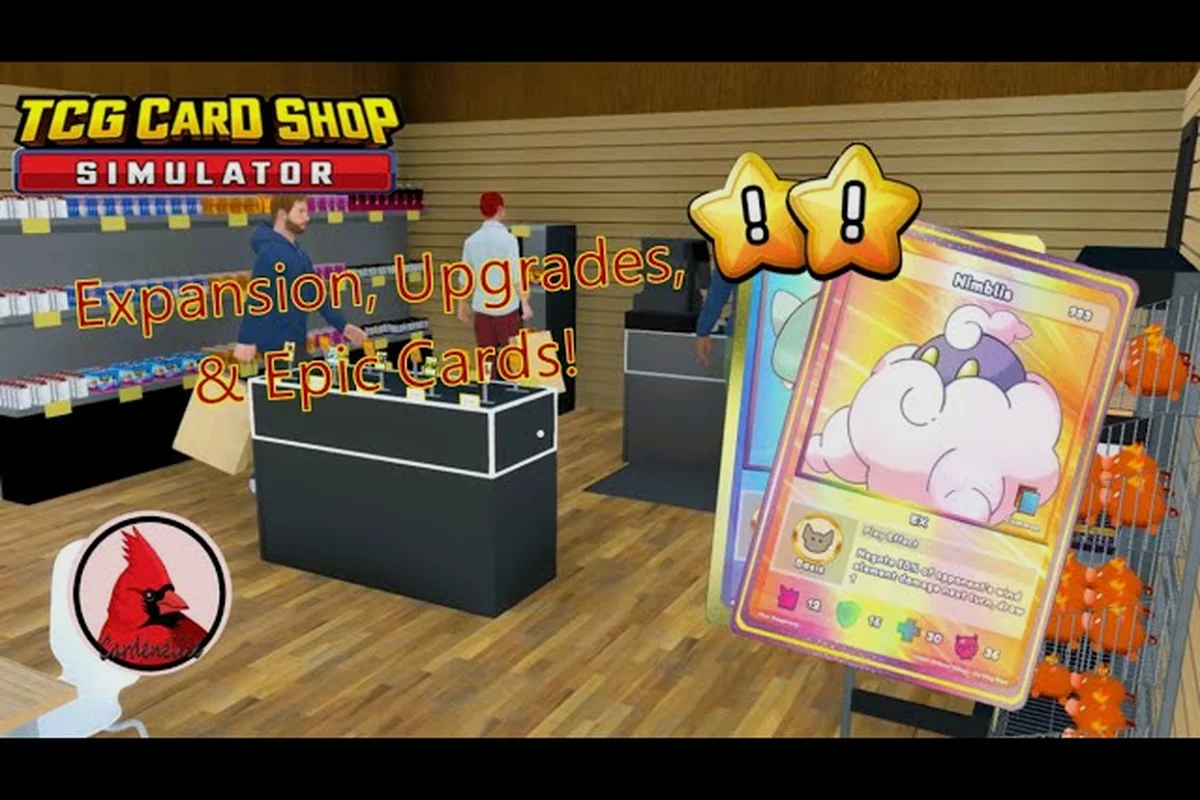
The TCG Card Shop Simulator newest expansion, Ascension, launched alongside the game's full 1.0 release on September 15, 2026, and it adds 1,452 fresh card numbers to a collection that already topped 2,900 entries across the Tetramon, Destiny, and Ghost lines. That single drop changes how every shop owner should think about pack margins, wholesale ordering, and long-term inventory planning, because the Ascension pool is the largest single addition in the game's Early Access history. Operators who locked in their restock plans before launch now have to rethink what to keep on the shelf and what to flip while supply is still soft.
According to the official announcement feed on the TCG Card Shop Simulator Steam store page, the 1.0 build ships with a 4,436-card total collection, ten supported languages, 50 Steam achievements, and cross-platform support across PC, Xbox, PlayStation, and Nintendo Switch. The shop itself holds up to 28 customers at once, and Ascension is the first set designed for that fully scaled customer count rather than the smaller queues from Early Access builds. This guide breaks down what Ascension adds, how it interacts with the four existing set families, and what the economics look like for retail versus wholesale in the weeks after launch.
What Ascension Adds to the Card Pool
Ascension is the fifth set family in TCG Card Shop Simulator, sitting alongside the original Tetramon base, the Destiny line, the Ghost cards, and the supplementary Battle Deck products. The expansion splits into four pack tiers and a sealed box product, mirroring the structure of Destiny so veterans can apply the same wholesale logic they already know. Each tier pulls from a different rarity band, and the Legendary tier carries the chase holos that tend to drive sealed pack value for the first several weeks of a new set's life. stiny so veterans can apply the same wholesale logic they already know, and you can cross-check how each band translates to expected hits per box in our Pack Pull Rates breakdown to make sure the per-pack cost on the Legendary tier lines up with what the holo chase rate actually supports.
Ascension Pack Tiers and Box Product
| Pack Tier | Rarity Focus | Box Size (Packs) | Typical Wholesale Cost | Typical Retail Tag |
|---|---|---|---|---|
| Basic Ascension | Common / Uncommon | 24 | 2,400 in-game | 4,800 in-game |
| Rare Ascension | Rare / Epic | 12 | 3,600 in-game | 7,200 in-game |
| Epic Ascension | Epic / Legendary | 6 | 4,200 in-game | 8,400 in-game |
| Legendary Ascension | Legendary / Holo | 3 | 5,400 in-game | 10,800 in-game |
| Ascension Sealed Box | Mixed (1 of each) | 1 box = 45 packs | 14,500 in-game | 29,000 in-game |
The Ascension Sealed Box is the format most worth buying in bulk at wholesale, because the box already bundles one pack from every tier plus a chance at a bonus holo insert. Community testing on the Steam discussions board suggests the box hovers around a 99% expected return when you crack and sell individually, while the same math on loose Basic Ascension packs drops into the 60-70% range because the commons flood the singles market within the first ten days. For shop owners who prefer to keep product on the shelf rather than crack for singles, the Rare and Epic Ascension tiers are the safest unopened pack value holds, since Legendary supply stays thin and Basic moves too fast to hold for margin.
Card Numbering and Collection Book Impact
The Collection Book tracks completion across all four set families, and Ascension slots in as set number five with card numbers running from A-001 through A-1,452. That numbering is intentional, because it gives the existing Tetramon, Destiny, and Ghost entries room to grow with future sub-sets without renumbering the entire catalog. Planning which family to finish first matters more than chasing every border of every creature across all four separate set lines, and the 1.0 build added a completion bonus that pays out 5,000 in-game per set finished. Finishing Ascension first is the fastest path to that bonus, because the new cards are the most densely stocked across every vendor in the game.
How Ascension Reshapes Pack Margins and Retail vs Wholesale Decisions
The Ascension drop landed at the same time the 1.0 patch rebalanced wholesale pricing across the entire catalog, which means historical margin data from Early Access is no longer a reliable baseline. Wholesale costs dropped roughly 8-12% on most tier products, but retail demand softened in the first week because every shop owner was restocking at the same time. The net effect is a compressed margin window for anyone buying Ascension at wholesale on launch day and trying to flip singles for profit.
Margin Comparison: Loose Packs vs Sealed Boxes vs Singles
| Product Strategy | Capital Required | Expected Margin (Day 1-7) | Expected Margin (Day 8-30) | Risk Level |
|---|---|---|---|---|
| Loose Basic Ascension Packs | Low (2,400 per box) | 15-20% | 5-10% | Low |
| Loose Rare Ascension Packs | Medium (3,600 per box) | 25-30% | 20-25% | Medium |
| Loose Legendary Ascension Packs | High (5,400 per 3-pack) | 10-15% (volatile) | 30-40% | High |
| Ascension Sealed Boxes (crack & sell) | Very High (14,500 per box) | 95-100% | 90-95% | Medium |
| Ascension Sealed Boxes (hold unopened) | Very High (14,500 per box) | 0% (no flip yet) | 40-60% (after 30+ days) | Low |
| Singles (buy low, list high) | Variable | 50-200% on holos | 20-50% | High |
The retail vs wholesale split really comes down to capital and patience. Wholesale boxes remain the single best margin per unit of capital, but the 14,500 per box floor price means new shop owners cannot access that strategy until their cash flow stabilizes. For most operators, the smarter play is to buy two Ascension Sealed Boxes at wholesale, crack them immediately, and list the Legendary pulls at a 100-150% markup during the first week, when the chase holo demand is hottest. The 8-12% wholesale discount is what makes that math work, because paying retail on the same boxes would compress the margin to the point where cracking is barely profitable.
Unopened Pack Value Over Time
Unopened pack value behaves differently from singles, because collectors pay a premium for factory-sealed product once a set rotates out of active print runs. Ascension is a permanent addition to the catalog, so there is no planned rotation yet, but the way past sets have held their value gives a clear pattern. Tetramon base sealed boxes roughly doubled in unopened pack value over the first six months after they stopped being the freshest set on the shelf, because supply dried up and nostalgia kicked in. Destiny followed the same arc, with a smaller multiplier because the line had a shorter print run. Ascension will likely follow the Destiny pattern, with sealed box unopened pack value climbing 40-60% over the first 30-60 days after the launch rush dies down and then stabilizing once the next future expansion drops.
Future Expansions and the Long-Term Set Roadmap
OPNeon Games has not published a hard roadmap for TCG Card Shop Simulator future expansions yet, but the Steam discussions board and the 1.0 launch trailer both hint at a quarterly release cadence. The trailer teases a winter-themed set family with ice-type creatures and a corresponding Battle Deck variant, which would push the total card count past 5,000 by the end of 2026 if the math holds. Community data on the Reddit forum also points to a possible spring 2027 set that reintroduces older creatures with alternate holo borders, giving collectors a reason to go back and re-grab cards they already own.
Confirmed vs Rumored Future Expansions
| Set Name | Status | Expected Card Count | Theme | Estimated Release |
|---|---|---|---|---|
| Ascension | Confirmed / Live | 1,452 | Mythic creatures, gold borders | September 15, 2026 (shipped) |
| Frostfall (rumored) | Teased in trailer | ~800-1,000 (community estimate) | Ice-type creatures, frost holo borders | Q4 2026 |
| Echoes (rumored) | Community-leaked | ~600-800 (community estimate) | Reprints with alternate holo borders | Q1-Q2 2027 |
| Cross-Set Crossover (rumored) | Unconfirmed | ~400 (community estimate) | Mix of all four families | Late 2027 |
Set completion is tracked through the Collection Book, so planning which family to finish first matters more than chasing every border of every creature across four separate set lines, and that rule will only get harder to follow once Frostfall and Echoes ship. The smartest move for completionists is to lock in Ascension completion before Frostfall lands, because the in-game completion bonus is fixed at 5,000 per set regardless of the set's size. A 600-card Echoes set would pay the same completion bonus as the 1,452-card Ascension set, which means the marginal per-card reward is far higher on the smaller sets once they start appearing.
Practical Tips for Stocking and Selling Ascension Product
The single most common mistake new shop owners make in the first week of a new expansion is buying too much Basic product and too little Rare or Epic. Basic Ascension packs are the cheapest wholesale, but the commons they produce flood the singles market within days and crash the per-card value to near-zero. A more balanced approach is to allocate roughly 60% of wholesale capital to Rare and Epic tiers, 25% to Sealed Boxes, and only 15% to Basic stock. That allocation keeps the shelves stocked with the packs that customers actually want to crack during the hype window while preserving enough sealed inventory to ride the unopened pack value curve later.
Restock Priority Cheat Sheet
| Priority | Product | Buy Frequency | Shelf Space Allocation | Why |
|---|---|---|---|---|
| 1 | Rare Ascension Packs | Daily during week 1, then weekly | 30% of pack shelf | Best margin-to-turnover ratio |
| 2 | Epic Ascension Packs | Every 2-3 days | 20% of pack shelf | High margin, slower turnover |
| 3 | Ascension Sealed Boxes | Weekly wholesale order | 15% of pack shelf | Long-term unopened pack value hold |
| 4 | Legendary Ascension Packs | Every 2-3 days | 15% of pack shelf | Volatile, but high ceiling |
| 5 | Basic Ascension Packs | Bi-weekly | 20% of pack shelf | Cheap entry, fast turnover, low margin |
Every pack tier has a matching box product, and boxes are the format most worth buying in bulk at wholesale, which is why the Restock Priority Cheat Sheet ranks the Sealed Box third but flags it as the highest-margin item per unit. The reason it is not ranked first is the capital lockup, because tying 14,500 in a single box per wholesale cycle slows the rest of the restock rotation. A more sustainable approach for mid-tier shop owners is to alternate: one week buy a Sealed Box at wholesale, the next week crack it and reinvest the singles revenue into two Rare Ascension pack orders.
If the goal is to maximize pack margins on Ascension singles rather than unopened pack value, the timing matters more than the volume. The first 72 hours after launch are when Legendary holo singles carry the highest markup, but they also have the highest floor risk if the meta shifts quickly. Community data from the Destiny launch shows that Legendary holos that dropped out of the meta within the first two weeks lost 40-60% of their singles value, while meta-stable holos held or gained. Operators who can read the meta early enough should list Legendary holos on the secondary market within the first 48 hours, then rotate that capital into Rare and Epic singles that have a steadier demand curve.
How Ascension Interacts with Existing Set Families
One of the more interesting design choices in the TCG Card Shop Simulator expansions lineup is that Ascension does not replace any of the four existing set families. The Tetramon base, Destiny, Ghost, and Battle Deck lines all continue to receive vendor stock, and the Collection Book still tracks them as separate completion goals. The practical effect is that shop owners now have to maintain inventory across five different product lines instead of four, and the shelf space allocation math has to shift accordingly.
A reasonable target for a mid-game shop is roughly 40% Ascension inventory, 25% Tetramon, 15% Destiny, 10% Ghost, and 10% Battle Deck products, with the percentages flexing based on local customer demand. The Ascension share is intentionally the highest because it is the freshest set, and the Ghost share is intentionally the lowest because Ghost cards have the slowest turnover in the post-launch economy. Operators who run the standard 1.0 build with the maximum 28-customer queue should also factor in that each customer can buy up to three packs per visit, which means the shelf needs at least 84 packs of stock at any given moment to keep the queue from blocking on empty bins. That minimum shifts up if multiple Ascension pack tiers are stocked side by side, because customers will skip a tier if it runs dry rather than settle for a different product.
The wholesale discount tier is another lever that interacts with Ascension more strongly than it did with older sets. The 1.0 build added a volume bonus that kicks in at 10+ boxes per wholesale order, and that bonus stacks across all five set families. Operators who are already buying Tetramon and Destiny boxes at wholesale should bundle their Ascension orders into the same weekly cycle to hit the volume threshold more reliably, because the 3% additional discount on a 50,000 order is meaningful margin on its own.
Frequently Asked Questions
What is the TCG Card Shop Simulator newest expansion?
The TCG Card Shop Simulator newest expansion is Ascension, which launched on September 15, 2026 alongside the 1.0 full release. It adds 1,452 new card numbers across four pack tiers and a sealed box product, bringing the total collection to 4,436 cards across five set families. Ascension is the largest single set addition in the game's history and is designed to support the fully scaled 28-customer shop layout that ships in 1.0.
What is the unopened pack value outlook for Ascension boxes?
Community data from the Tetramon base and Destiny launches suggests sealed boxes double in unopened pack value over six months once they stop being the freshest set on the shelf. Ascension will likely follow the Destiny pattern with a 40-60% unopened pack value gain over the first 30-60 days after the launch rush, then stabilize once the next future expansion drops. The 1.0 build also added a factory-seal verification system that helps collectors confirm they are buying genuinely unopened product, which supports the long-term unopened pack value curve.
What TCG Card Shop Simulator future expansions are coming next?
OPNeon Games has not published a hard roadmap, but the official launch trailer teases a winter-themed set codenamed Frostfall for Q4 2026 with ice-type creatures and frost holo borders. Community data from the Reddit forum also points to a possible spring 2027 reprint set called Echoes that reintroduces older creatures with alternate holo borders, and an unconfirmed late-2027 crossover set. The expected cadence is roughly one major expansion per quarter, which would push the total card count past 5,000 by the end of 2026.
Should I buy Ascension at retail or wholesale for the best margins?
Wholesale is the better choice for any operator with at least 15,000 in starting capital, because the 8-12% discount is what makes cracking Sealed Boxes profitable. Retail purchases only make sense for very small restocks or for topping off Legendary Ascension stock when wholesale is sold out. The wholesale order cycle resets every 24 in-game hours, so planning two to three orders per week is the most efficient way to capture the discount without overcommitting capital.
How does the retail vs wholesale split affect Ascension inventory strategy?
The retail vs wholesale split should sit around 70% wholesale and 30% retail for Ascension during the first month, because the wholesale discount is the primary margin driver on Sealed Boxes and Rare/Epic packs. Retail purchases are best reserved for Legendary Ascension restocks when wholesale cycles are missed, and for last-minute Basic Ascension top-offs. Operators who flip the ratio and buy more retail than wholesale will see their pack margins compress by 10-15% on the same volume, which adds up quickly across a 50,000 weekly restock budget.