
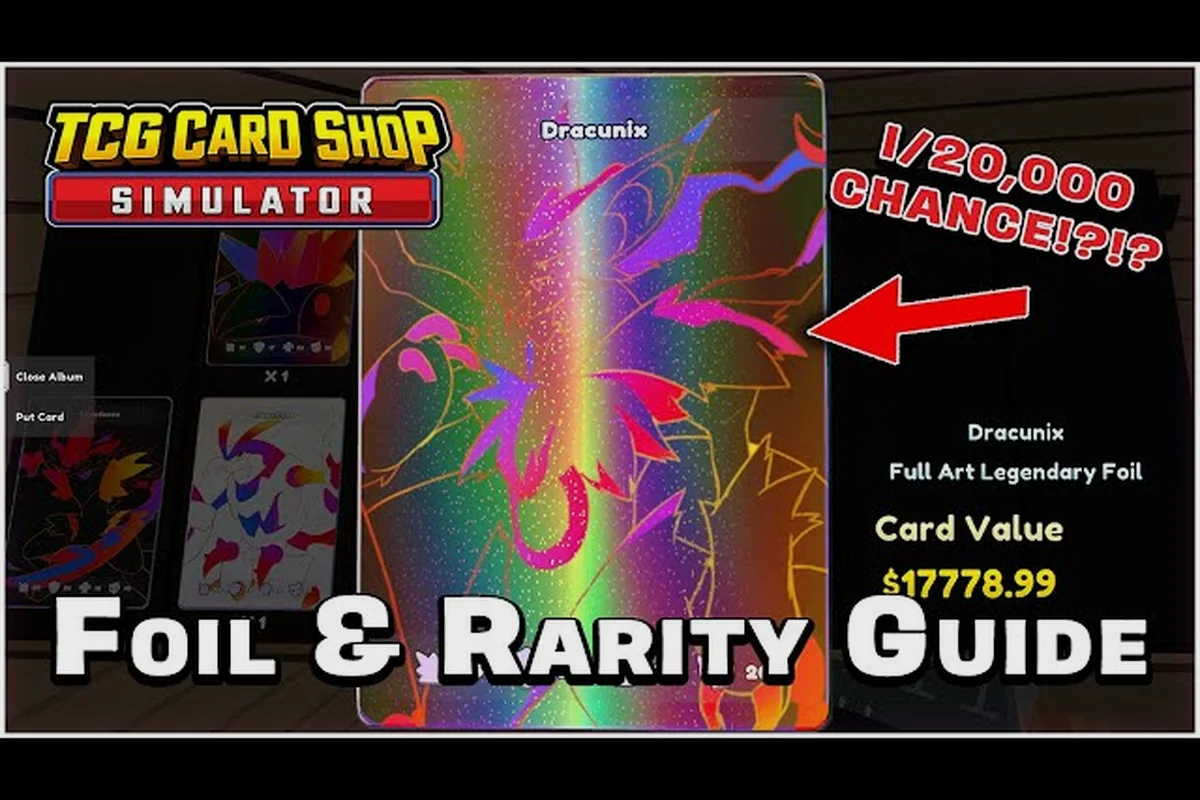
Holo cards in TCG Card Shop Simulator are the most collectible prints in the entire Tetramon catalog, and their prices swing harder than any other border on the secondary market. Understanding which holo prints hold value, which border combinations produce the rarest hits, and how Cardinal's Grading reshapes your sell price is the difference between a binder full of trade fodder and a showcase shelf that pays for your next renovation. This guide walks through border print mechanics, foil stacking, the priciest specimens, grading economics, and the live pricing quirks that determine whether a holo is worth holding or dumping.
How Holo Cards Are Built in TCG Card Shop Simulator
Every Tetramon card in the 4,436-card collection is defined by two layered attributes: a border print and a foil state. The border print (Base, First Edition, Silver, Gold, EX, or Full Art) is fixed at pull time, while foil is a separate state that can stack on top of any border. According to the community video hub on Steam, holo behavior is governed by these exact mechanics, and knowing how they interact is the foundation of every valuation decision.
The Six Border Prints
The border print determines the card's visual frame and acts as the single strongest value driver in TCG Card Shop Simulator, because each variant sits on its own independent supply curve with separate pull rates from booster packs and a distinct aesthetic demand curve among collectors chasing TCG Card Shop Simulator holo cards. For example, a Base holo may roll in roughly 1 of every 8 packs, while a Full Art holo drops closer to 1 in 800, and that 100x supply gap is what lets shop owners price a Full Art 30-50x above a same-rarity Base even before any TCG Card Shop Simulator card grading premium is applied.
| Border Print | Visual Cue | Supply Rarity | Typical Value Ceiling |
|---|---|---|---|
| Base | Black border, standard frame | High | Lowest of the six |
| First Edition | White line inside the border | Low | Strong premium over Base |
| Silver | Silver border shimmer | Very low | Mid-to-high |
| Gold | Gold border | Very low | High |
| EX | Purple border with yellow line | Extremely low | Very high |
| Full Art | Borderless, art fills the card | Extremely low | Highest in the catalog |
Players chasing TCG Card Shop Simulator's most expensive card almost always land on a Full Art holo, because the borderless frame combined with a foil state creates the rarest visual combination in the game, and the math backs it up: a Base holo that rolls in roughly 1 of every 8 packs at a ~12.5% pull rate sits next to a Full Art holo at approximately 1 in 800, a 100x supply gap that pushes shop pricing 30-50x higher before any TCG Card Shop Simulator card grading premium is applied. That is also why TCG Card Shop Simulator cardinal grading separates the two tiers sharply, with mint Full Art holos routinely clearing the highest value ceiling in the catalog while a scratched Full Art foil can collapse to Base-holo territory.
Foil Stacking and the Holo State
A card becomes a "holo" when its foil state activates on top of any non-Base border. Foil is binary in the sense that it either appears or it doesn't, but the perceived value multiplier is anything but flat. A Silver foil sits comfortably above a First Edition foil, while a Gold or EX foil can multiply a card's baseline value by 5-10x depending on the creature. Full Art holos are the apex because both the border and the foil layer are pulling maximum rarity weight at the same time.
Element and Creature Synergy
Every card belongs to a creature family and one of four elements (Fire, Water, Earth, Wind). Element and creature popularity are the third valuation layer, because some creatures pull more pack weight in the meta and generate excess supply that softens prices. A Fire holo of a niche creature is almost always worth more than a Wind holo of a meta-staple creature, because meta-staples flood the pack pool.
Card Values: What Actually Moves the Market
The TCG Price app reports live market value for every card in the collection, and that value moves with the trends and events you host, so a card worth holding today can be worth dumping tomorrow depending on which category your next event pushes up. According to community data on the Steam forum board, this volatility is intentional, and experienced clerks treat the app as a timing tool rather than a static price tag.
Price Drivers at a Glance
| Driver | Effect on Value | Notes |
|---|---|---|
| Border print | Largest single multiplier | EX and Full Art dominate |
| Foil state | Multiplies border premium | Stacks with border rarity |
| Creature popularity | Supply-driven discount | Meta-staples flood packs |
| Element demand | Event-tied swings | Hosting Fire events pushes Fire values |
| Grading tier | Cardinal multiplier | GEM MINT doubles Base-tier prices |
| Set rotation | Long-term decay | Older sets lose 30-50% after rotation |
Reading the TCG Price App
The TCG Price app surfaces three numbers: a base value, a recent sale range, and a 7-day trend arrow. The trend arrow is the most underused signal, because it tells you whether the next event cycle will push the card up or whether the market is cooling. Cards with a rising trend and a low recent sale count are the cleanest "buy and grade" candidates, while cards with a flat trend and a high sale count are best flipped raw.
The Rarest Hits and Most Expensive Cards
When players ask about TCG Card Shop Simulator's rarest card, the answer is always a Full Art holo of a high-demand creature, ideally pulled from a limited-run event pack. The exact creature shifts with each patch, but the underlying rarity profile stays the same.
Top-Tier Holo Categories
| Tier | Border | Foil | Typical Pull Source | Price Bracket |
|---|---|---|---|---|
| S-Tier | Full Art | Holo | Limited event packs | Highest in catalog |
| A-Tier | EX or Gold | Holo | Booster packs (low odds) | 3-5x Base holo |
| B-Tier | Silver | Holo | Booster packs (moderate odds) | 1.5-2x Base holo |
| C-Tier | First Edition | Holo | Standard packs | Slight premium over Base |
| D-Tier | Base | Holo | Standard packs (common) | Entry-level holo |
For a deeper breakdown of the underlying print and rarity system, the card list breakdown catalogs every creature family and the border odds per pack type, which makes it easier to triangulate where the rarest hits actually come from.
Border-by-Border Comparison
The cleanest way to think about TCG Card Shop Simulator's card values is to compare the same creature across borders. A single mid-tier creature pulled six times, once per border, will produce a price spread of 20x or more from the Base to the Full Art holo. That spread is why collectors hoard every Gold and EX pull regardless of the creature, because the border premium alone justifies storage cost.
Cardinal's Grading: How the Grading App Reshapes Value
Cardinal's Grading is the in-game card grading app, and it is the single most important tool for anyone holding a stack of holos. The grading app accepts any card, charges a fee scaled to the card's base value, and returns a grade between 1 and 10 that multiplies the card's sell price. A GEM MINT 10 holo can sell for roughly double the raw holo price, while a low grade can drop the card below raw value.
How Cardinal Grading Works
| Step | Player Action | Cost | Outcome |
|---|---|---|---|
| 1 | Open Cardinal's Grading app | Free | Browse the queue |
| 2 | Select a card from inventory | Grading fee (scaled) | Card locked in queue |
| 3 | Wait for grading to complete | Time-based | Grade 1-10 assigned |
| 4 | Accept or reject the grade | None | Accept = sellable graded card; reject = return to inventory |
| 5 | List in shop or store | Listing fee | Graded holo multiplies sell price |
The grading fee scales with the card's base value, so grading a Full Art holo costs significantly more than grading a Base holo, but the absolute profit from a high grade is also much larger. The trick is to grade only cards that have a realistic path to a 9 or 10, because anything below that often returns less than the grading fee.
When Grading Is Worth It
| Card Tier | Grade Target | Realistic Profit? | Recommendation |
|---|---|---|---|
| Full Art holo | GEM MINT 10 | Yes, high margin | Always grade |
| EX holo | 9 or 10 | Yes, moderate margin | Grade on a clean pull |
| Gold holo | 9 or 10 | Yes, moderate margin | Grade on a clean pull |
| Silver holo | 10 only | Marginal | Grade only pristine copies |
| First Edition holo | 10 only | Marginal | Grade only pristine copies |
| Base holo | 10 only | Often negative | Skip unless the card is meta |
For a complete cost-benefit analysis of grading versus raw selling, the grading worth-it guide walks through the math on every tier, including the break-even grade for each border print. That guide also models the cardinal grading app's turnaround fees against expected holo multipliers, so you can see exactly when a Base holo pulled from a booster pack will net more profit sold raw at shop counter versus shipped off to PSA, and how First Edition holo premiums shift the tipping point.
Cardinal Grading Quirks
Community testing suggests that grading outcomes are influenced by the card's in-game condition proxy, which factors in whether the card has been used in battles, displayed on the shop floor, or stored in a deck box. Pristine pulls that go straight from booster pack to grading queue have the best shot at a 10, while cards that have been played in a few matches often cap out at 7 or 8. This is why experienced clerks keep a separate "grading candidate" pile that never sees play.
Holo Card Strategy: When to Hold, Grade, and Flip
A working holo strategy is a three-way decision tree: hold for a market event, grade for a value multiplier, or flip raw while the demand is hot. Each path has a different risk profile, and the best clerks run all three in parallel depending on the card.
The Hold-and-Wait Path
Holding works best for Full Art and EX holos of niche creatures, because their supply is so thin that any event that touches their element or creature family can spike the price 30-50% in a single cycle. The downside is shelf space, because stored holos occupy inventory slots that could otherwise be turning over cheaper cards. The shelf space value breakdown covers how to calculate the per-slot ROI on stored holos versus active flip stock.
The Grade-and-Sell Path
Grading is the highest-effort path, but it produces the cleanest margin on top-tier holos. The workflow is straightforward: pull, inspect for centering and surface condition, submit to Cardinal's Grading, accept only 9 or 10 results, list on the shop floor at the multiplied price. For more on how to optimize the in-store display once the graded card is ready, the card display guide covers pricing tactics and bulk-listing strategies.
The Flip-Raw Path
Flipping raw is the default path for everything that doesn't pass the grade-and-sell filter. Raw holos sell faster, require no grading fee, and free up shelf space immediately. The optimal flip window is during an event that matches the card's element, because the TCG Price app tends to spike 24-48 hours before the event officially starts.
Element Targeting for Events
| Element | Typical Event Trigger | Best Holo Categories to Stock |
|---|---|---|
| Fire | Fire-type tournaments | Fire EX, Fire Full Art |
| Water | Water-type tournaments | Water EX, Water Full Art |
| Earth | Earth-type tournaments | Earth EX, Earth Full Art |
| Wind | Wind-type tournaments | Wind EX, Wind Full Art |
Because events push TCG Card Shop Simulator card values up by element, the cleanest way to predict a price swing is to track which event is queued on the in-game calendar and stock the matching holos a day in advance. For the full mechanics on how elements, creatures, and rarity tier up across evolutions, the card elements breakdown is the most thorough reference.
Pricing Live, Selling Smart, and Avoiding Common Pitfalls
The TCG Price app is the only authoritative price source in TCG Card Shop Simulator, and the live market value it reports is what customers will pay on the shop floor. According to the game's official store page on Steam, the collection spans 4,436 cards across the full Tetramon catalog, which means the price discovery problem is real, and pricing blind is one of the most common ways new clerks leave money on the table.
Live Pricing Rules
| Scenario | Recommended Action | Reason |
|---|---|---|
| Rising trend, low sale count | Hold or grade | Incoming event likely to spike |
| Rising trend, high sale count | Flip raw now | Trend may exhaust before grading returns |
| Falling trend, low sale count | Hold for next event | Recovery candidate |
| Falling trend, high sale count | Dump immediately | Oversupply is the dominant signal |
Common Holo Pitfalls
New clerks tend to make the same three mistakes with holos: grading too aggressively, holding too long, and underpricing on the shop floor. Each one is fixable once you understand the underlying signal. Grading a Silver holo with a bent corner is a guaranteed loss, holding a Base holo through two event cycles is wasted shelf space, and pricing a Full Art holo 10% below the TCG Price app's recent sale range is a pure giveback.
The shift from beginner to intermediate holo trader comes down to reading the trend arrow, knowing the grading break-even grade for each tier, and rotating stock fast enough that shelf space stays productive. Once those three habits click, holos stop being lucky pulls and start being a reliable profit center.
Frequently Asked Questions
What is the rarest card in TCG Card Shop Simulator?
The rarest card tier in the catalog is the Full Art holo, which combines the rarest border print (borderless) with a foil state. These pulls are extremely rare from booster packs and tend to come from limited event packs instead.
How does Cardinal's Grading work?
You open the Cardinal's Grading app, select a card from your inventory, pay a scaling grading fee, and wait for a grade between 1 and 10. A grade of 9 or 10 multiplies the card's sell price, while a grade of 7 or below usually returns less than the grading fee cost.
Should I grade every holo I pull?
No. Grading is only worth it on Full Art, EX, and Gold holos, and only when the card is pristine. Silver and First Edition holos should be graded only if you have a confirmed mint copy, because lower grades often result in a net loss after the grading fee.
How do I check live card values in the game?
The TCG Price app shows the current market value, recent sale range, and a 7-day trend arrow for every card. The trend arrow is the most useful signal for timing, because it tells you whether the next event cycle is likely to push the price up or down.
Do events change holo card prices?
Yes. Events that match a card's element push the price of that element's holos up 30-50% during the event window. Stocking the matching holos a day in advance and selling during the event is the cleanest short-term profit play in the game.